Free Case Evaluation
You will never be charged a fee unless a recovery is made for you.

Trustwell Law is accepting cases nationwide on behalf of people who had an endoscope procedure to examine their digestive tract and then (within 90 days) developed an infection (superbug, tuberculosis, HIV) or sepsis requiring hospitalization.
If you or a loved one is considering filing an Olympus endoscope lawsuit, call us at 800-796-1636 or submit your contact details online and someone will contact you shortly. You pay nothing unless your lawsuit is successful and you receive compensation.
At Trustwell Law, our experienced attorneys take a personalized, compassionate approach. We cut through the legalese and partner with our clients. We also have access to the expertise, resources, and manpower to fully investigate each case and fight for and with our clients to get the justice they deserve.
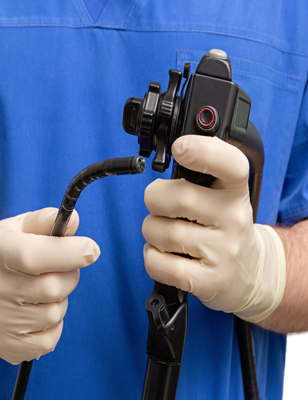
Every year, millions of Americans undergo routine diagnostic procedures such as colonoscopies and endoscopies. These procedures rely on flexible medical scopes to look inside the body to identify illnesses and avoid invasive surgeries. However, a growing body of legal actions and regulatory recalls reveal a severe danger: certain reusable medical scopes possess deep design flaws that can prevent them from being properly sterilized, leaving patients vulnerable to life-threatening bacterial infections.
An endoscope is a highly specialized medical instrument consisting of a long thin, flexible tube equipped with a light source and a miniature camera. Doctors insert these scopes into the body through natural openings (such as the mouth or rectum) or through small surgical incisions to view internal organs on a monitor screen in real-time.
There are several variations of these scopes tailored to specific organs:
Because these instruments cost thousands of dollars, hospitals do not discard them after a single procedure. They are manufactured to be reusable, meaning they must undergo strict, multi-step decontamination and high-level chemical disinfection before they can be used on next patient.
The core issue driving nationwide lawsuits against major medical manufacturers—such as Olympus—is that these scopes may remain highly contaminated with dangerous bacteria even after undergoing rigorous sterilization.
According to safety alerts published by the U.S. Food and Drug Administration (FDA), testing revealed that as many as 1 in 20 closed-channel duodenoscopes still harbor high-concern bacteria after finishing the completion of manufacturer-recommended cleaning protocols.
This persistent contamination causes patient-to-patient transmission of bacteria. Tissue, blood, and infected bodily fluids from a prior patient can remain trapped inside the scope, shielding bacteria from disinfectants and directly seeding that infection into the bloodstream or internal cavities of subsequent patients.
For years, manufacturers deflected blame for this problem by suggesting that hospital staff were failing to wash the devices correctly. But rigorous investigations by federal agencies including the Centers for Disease Control and Prevention (CDC) have established that these outbreaks happen even when hospital technicians execute every sanitation step perfectly.
The failure is rooted in a fundamental design defect:
The physical consequences of a contaminated scope procedure are severe and fast-acting, often manifesting within days or weeks of the initial appointment and include sepsis and infections including HIV as well as:
If you or a loved one were harmed by an Olympus endoscope, contact us to discuss filing an Olympus endoscope infection lawsuit. The consultation is free. You pay nothing unless you win your case and receive compensation.
Sources
American Hospital Association. (2026, January 22). Olympus expands recall of endoscope needles. Retrieved from https://www.aha.org/news/headline/2025-09-24-fda-issues-class-i-recall-olympus-endoscope-needles
Centers for Disease Control and Prevention. (2015, February 19). Los Angeles County/UCLA investigation of CRE transmission associated with duodenoscopes. Retrieved from https://archive.cdc.gov/www_cdc_gov/hai/outbreaks/cdcstatement-la-cre.html
Gastroenterology & Endoscopy News. (2019, January 29). FDA Issues Safety Alert on Duodenoscope Reprocessing Study. Retrieved from https://www.gastroendonews.com/FDA-Update-and-Product-News/Article/01-19/FDA-Issues-Safety-Alert-on-Duodenoscope-Reprocessing-Study/53850
U.S. Food & Drug Administration. (2025, June 24). Import Alerts for Certain Olympus Medical Devices Manufactured in Japan: Letter to Health Care Providers. Retrieved from https://www.fda.gov/medical-devices/reprocessing-reusable-medical-devices/infections-associated-reprocessed-duodenoscopes
U.S. Food & Drug Administration. (2026, April 8). Medical Device Recalls Database: Olympus OER-Pro automated endoscope reprocessor. Retrieved from https://www.fda.gov/medical-devices/medical-device-recalls-and-early-alerts/endoscope-instrument-recall-olympus-removes-single-use-guide-sheath-kits-due-risk-radiopaque-guide
